
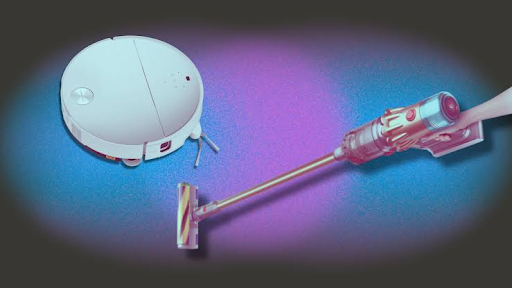
If your floors are mostly hard surface and reasonably clear, a robot vacuum saves more time because it runs while you are at work. If you have carpets, stairs, pets that shed heavily, or a flat where the floor is never entirely clear of shoes and cables, a cordless stick vacuum will actually get your home cleaner. Most households that can afford both end up running a robot four or five times a week and a stick vacuum once a week for the parts the robot cannot reach.
The honest framing is that these two devices do different jobs. A robot maintains a baseline. A stick vacuum cleans. Buying a robot expecting it to replace vacuuming entirely is the single most common source of disappointment, and buying a stick vacuum expecting it to happen automatically is a misunderstanding of your own willingness to do chores on a Thursday evening.
What Each One Actually Does Well
A robot vacuum’s real strength is frequency. Running daily on a schedule, it removes dust, hair and crumbs before they get trodden into a rug, which keeps a flat at a consistent 80 percent clean rather than cycling between spotless and grim. Suction figures on robots have climbed considerably, with mid range models now quoting 4,000 to 8,000 Pa, though those numbers are marketing shorthand and say little about performance on a wool rug.
A cordless stick vacuum wins on control and edge work. You can push it hard into a corner, run it along a skirting board, take it up the stairs, do the sofa with a crevice tool, and clean the car boot in the same session. Runtime typically sits at 40 to 60 minutes on eco mode and drops to 6 to 12 minutes on maximum power, which is fine because almost nobody vacuums a whole flat on boost.
The gap that people underestimate is carpet. Deep pile carpets and thick rugs need the mechanical agitation of a motorised brush bar pressed down with weight behind it, and a 3.5 kilogram robot cannot supply that. Robots skim carpets. Sticks clean them. If your bedroom has a proper carpet, that difference shows up within a month.
Time, Effort and What Maintenance Really Involves
The time argument for robots is real but not as clean as the marketing suggests. Yes, the machine runs unattended. But you spend five minutes tidying the floor beforehand, and then twice a week you empty a small bin, cut hair off the brush roll, wipe the sensors and clear the side brush. Anti tangle brush designs have improved this substantially, and self emptying base stations extend the interval to somewhere between 30 and 60 days, but they cost an extra CHF 200 to CHF 400 and they are loud when they dock.
Stick vacuums demand your presence and almost nothing else. Empty the bin after each use (about ten seconds), rinse the filter every month, and clear the brush bar occasionally. Batteries are the real consumable, usually holding good capacity for around three to five years before runtime noticeably drops, and a replacement pack runs CHF 60 to CHF 150 depending on brand. Check that the model you are considering has user replaceable batteries, because some do not.
Robot vacuums have more that can go wrong. Wheels, cliff sensors, LiDAR turrets, mopping pumps and docking contacts all fail eventually, and a machine with a mop function adds a water tank and dirty pads to your maintenance list. Consumer testing organisations that survey owners at scale report hair tangled in the rollers and battery problems as the two faults robot owners hit most often, which is what you would expect from something with three times the moving parts.
Cost Over Five Years, Not on the Day You Buy
A usable robot vacuum starts at around CHF 250, a good mapping model with decent navigation sits at CHF 400 to CHF 700, and a self emptying flagship with mopping runs CHF 800 to CHF 1,500. Cordless sticks start at CHF 150 for something basic, land at CHF 300 to CHF 500 for a genuinely good one, and top out around CHF 900.
Add consumables to both. Robot filters, side brushes and mop pads cost roughly CHF 40 to CHF 90 a year, plus disposal bags for self emptying docks at around CHF 5 to CHF 8 each. Stick vacuums cost far less to run, maybe CHF 20 to CHF 40 a year in filters, with the battery replacement as the one lumpy expense. Over five years, a mid range robot with a dock realistically costs CHF 900 to CHF 1,300 all in, while a mid range stick sits closer to CHF 450 to CHF 600.
Availability of spare parts matters more than the sticker price and is worth checking before you commit. Comparing what is actually stocked locally, whether on a Swiss retailer like pandaloo.ch or at a specialist shop, tells you whether you will still be able to buy a filter for that model in four years. Brands that vanish from a market leave you with a working machine and no consumables, which is how perfectly good vacuums end up at the recycling centre.
Which One Fits Your Type of Home
A single floor flat of 60 to 100 square metres with parquet or tiles is the ideal robot scenario. Set it to run at 10:00 on weekdays, come home to clean floors, and use a small handheld for the sofa. If that describes you, a robot is a genuine quality of life upgrade and you may barely use a stick vacuum.
Maisonettes, terraced houses and anything with stairs flip the answer. No robot handles stairs, and buying one per floor is absurd for most budgets. In a multi storey home a cordless stick is the primary tool, and a robot only makes sense if the ground floor is large and open enough to justify it on its own.
Households with pets sit somewhere in the middle and usually need both. Shedding dogs and long haired cats generate hair faster than a weekly clean can handle, so daily robot runs keep it under control, but you will still need the stick vacuum for the sofa, the bed, the stair edges and the corner where the hair actually collects. Families with small children have a different problem, which is that the floor is rarely clear enough for a robot to run without eating a sock or redistributing a raisin.
Renters and people who move often should weight portability. A stick vacuum comes with you, needs one wall bracket, and works anywhere. A robot needs remapping, docking space near a socket, and often a threshold layout it can handle, which changes with every flat.
Living With Them Day to Day
The behavioural effect of a robot is more interesting than the cleaning. People who own one tend to keep floors clearer, because the machine punishes clutter by getting stuck, and that tidiness habit is worth something on its own. The flip side is a low grade nagging awareness of a device that occasionally beeps for help from under the bed at 11:00.
Noise is a real consideration in a flat. Robots run at roughly 55 to 70 decibels, which is conversation level and tolerable, but a self emptying dock spikes to 80 or more for 15 to 20 seconds, and doing that at seven in the morning in a Swiss apartment building is a fast way to meet your neighbours. Schedule runs for when nobody is home, not for when you are having breakfast.
If you can only buy one thing this year, buy the cordless stick. It works in every home, it never needs mapping, it handles the messes that actually stress you (broken glass, spilled cereal, the litter tray area), and it holds its usefulness even after you add a robot later. Then watch how often you actually reach for it, and if the answer is three times a week on the same open floor area, that is the case for automating that part and buying the robot next.