
Have you ever wondered why many DAOs move so slowly? You see big ideas, big money, and big communities. But when it comes to making decisions, everything feels stuck. A simple vote can take days or even weeks. By the time the decision is made, the market has already moved on.
This is a real problem in Web3 today. Many people join DAOs with excitement. But later, they stop voting. Why? Because reading long proposals is tiring. Understanding risks is hard. And honestly, not everyone has time for it. So only a small number of people vote, and that creates even more problems.
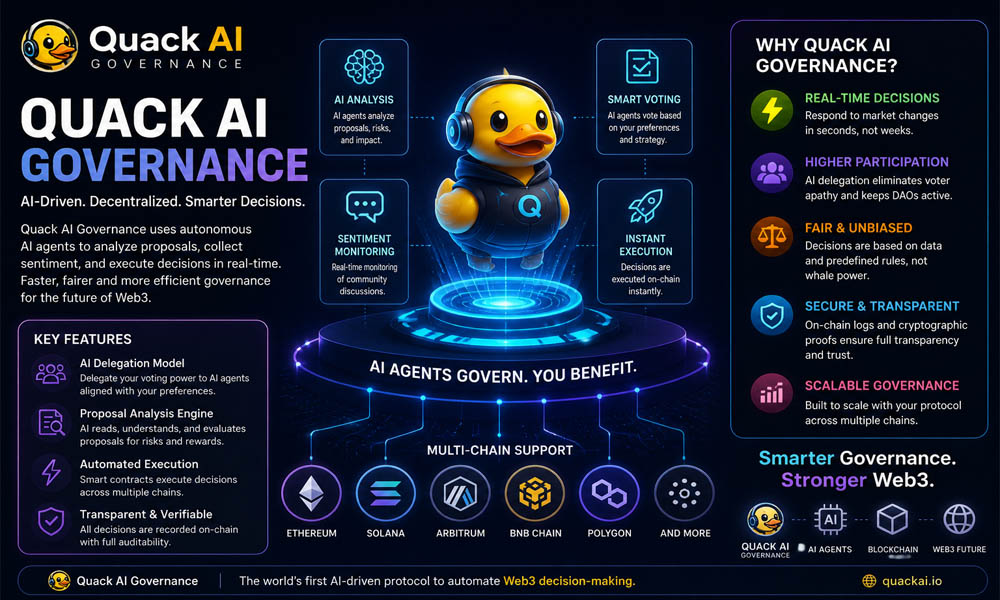
This is where Quack AI Governance comes in. It is a new way to run DAOs using smart AI tools. Instead of relying only on humans, it uses AI agents to help make decisions faster and smarter. In this article, we will explore how Quack AI Governance works, why it matters, and how it is changing DAO voting forever.
What Is Quack AI Governance?
Let’s keep it simple. Quack AI Governance is a system that uses AI to help DAOs make decisions. Instead of asking every user to vote manually, the system uses smart AI agents to handle the process.
Think of it like this. Imagine you have a smart assistant who understands your choices. This assistant reads every proposal, checks the risks, and votes the way you would want. That is exactly what Quack AI Governance does, but on the blockchain.
In normal DAOs, people must read, think, and vote every time. But in Quack AI Governance, AI does most of the hard work. It helps the DAO move faster, stay active, and make better decisions based on data, not emotions.
Why DAO Voting Feels Slow Today
Now let’s talk about the problem. Why are DAOs so slow?
First, voting is manual. Every proposal needs people to read and vote. But many people don’t have time for this. Life is busy. So they skip voting. This is called voter fatigue. Over time, fewer people take part.
Second, decisions take too long. A proposal can stay open for days or weeks. During that time, the market can change. Imagine a DeFi project needing to react fast to a price drop. But the vote is still open. That delay can cost money.
Another issue is confusion. Many proposals are long and hard to understand. Not everyone is an expert. So people feel unsure and avoid voting. This leads to very low participation, sometimes less than 10%.
Big Problems Quack AI Governance Solves
Because of these issues, DAOs face some serious problems. And this is where Quack AI Governance becomes important.
One big problem is low participation. When only a few people vote, decisions are not truly fair. Quack AI Governance solves this by letting AI vote on behalf of users, so participation stays high all the time.
Another problem is whale dominance. In many DAOs, people with more tokens have more power. They can control decisions. This is not fair for smaller users. With Quack AI Governance, decisions are more balanced because AI follows set rules and user preferences.
Speed is also a major issue. Traditional DAOs are slow. But Quack AI Governance allows faster decisions by automating the process. This means the DAO can react quickly to changes in the market.
How Quack AI Governance Works in Simple Words
So how does all of this actually work?
At the center of Quack AI Governance are AI agents. These are smart programs that can think, analyze, and act. They read proposals, study data, and understand what is happening in the DAO.
Let’s say a new proposal is created. The AI agent reads it. It checks past data, community feedback, and possible risks. Then it decides how to vote based on the user’s preferences.
After the vote, the system can also take action automatically. For example, it can release funds or update settings using smart contracts. This makes the whole process smooth and fast, without delays.
Quack AI Governance and the AI Delegation Model
One of the most interesting parts of Quack AI Governance is the AI delegation model.
In simple words, you can give your voting power to an AI agent. But this is not random. You first set your preferences. For example, you may prefer safe decisions or high-risk growth ideas.
Now imagine this. You are busy or offline. A proposal comes in. Your AI agent checks it and votes based on your choices. You are still part of the DAO, even without being active all the time.
This makes governance easier for everyone. It also keeps participation high. Even people who don’t vote manually are still involved through their AI agents.
How Quack AI Governance Analyzes Proposals
Let’s go deeper into how Quack AI Governance understands proposals.
Normally, proposals can be long and complex. They include data, plans, and risks. Many users find this hard to read. But AI agents can process all this information quickly.
The system reads documents, checks on-chain data, and even looks at community discussions. It tries to understand if the proposal is good or risky. Then it turns this complex data into simple insights.
For example, instead of reading a long document, users can see a simple summary. This helps both humans and AI agents make better decisions. It saves time and reduces confusion.
Quack AI Governance and Automatic Decision Execution
Now here is where things get even more powerful.
After a decision is made, Quack AI Governance does not stop. It also handles execution. This means the system can take action automatically without waiting for humans.
For example, if a proposal says to release funds, the system can do it instantly using smart contracts. No need for manual approval. No delays. Everything happens smoothly.
This is very useful in fast-moving areas like DeFi. Imagine needing to move funds quickly to avoid loss. With Quack AI Governance, the system can act in real time. That is a big advantage.
Where Quack AI Governance Is Used Today
You might be thinking, where is this actually used?
The good thing about Quack AI Governance is that it works in many areas. It is flexible and can be added to different types of projects. This makes it useful across Web3.
From finance to real-world assets, many sectors need fast and smart decisions. Traditional governance struggles here. But Quack AI Governance brings speed, clarity, and automation.
In the next part, we will explore real examples like DeFi, real-world assets, and cross-chain systems. You will see how this technology is already making a difference.
Quack AI Governance in DeFi Projects
Let’s start with DeFi, because this is where speed really matters. In DeFi, prices can change in seconds. A small delay can lead to big losses. But traditional DAO voting is too slow for this kind of environment.
This is where Quack AI Governance becomes very useful. AI agents can quickly check market data and make fast decisions. For example, if a token price suddenly drops, the system can react right away. It can move funds, adjust strategies, or protect the treasury without waiting for long voting periods.
Another big benefit is better fund management. Instead of guessing, the AI looks at past data and current trends. It helps decide where to invest or how to use funds wisely. This makes DeFi projects more stable and better prepared for sudden changes.
Quack AI Governance for Real-World Assets (RWA)
Now let’s talk about real-world assets. These include things like real estate, gold, or other physical assets that are turned into digital tokens. These systems need strong rules and clear records.
With Quack AI Governance, everything can be tracked and verified on the blockchain. This makes it easier to follow rules and meet legal needs. For example, if a project needs to show how funds were used, the system already has clear records.
AI also helps reduce human error. It checks if actions follow set rules before they happen. This builds trust. People feel safer knowing that decisions are not random but based on clear data and rules.
Quack AI Governance for Cross-Chain Voting
Web3 is not just one blockchain. It is spread across many networks like Ethereum, Solana, and others. This creates a new problem. How do you manage decisions across different chains?
Quack AI Governance solves this by working across multiple chains. It connects everything into one system. So instead of managing each chain separately, the AI handles everything together.
For example, imagine a DAO working on different platforms. A decision made on one chain may affect another. The AI makes sure everything stays in sync. This keeps operations smooth and avoids confusion.
Trust and Safety in Quack AI Governance
Many people ask an important question. Can we really trust AI to make decisions?
This is a fair concern. That is why Quack AI Governance focuses on transparency. Every decision made by AI is recorded on the blockchain. This means anyone can check what happened and why.
The system also uses strong security methods. It includes checks and proofs that confirm decisions are correct. Think of it like a double-check system. Before anything happens, the system verifies it.
This creates trust. Users are not left in the dark. They can see how decisions are made. This makes the system more open and reliable.
Quack AI Governance Token, App, and Rewards
Now let’s look at how users interact with the system.
Quack AI Governance has its own token called Q. This token is used for many things. Users can stake it, support AI agents, and take part in upgrades.
There is also a simple app interface. Even if you are not very technical, you can use it easily. You can set your preferences, choose your AI agent, and track decisions from one place.
Another interesting part is rewards. Users and developers can earn rewards for taking part in the system. For example, if your AI model is useful, you can earn from it. This creates a strong and active community.
Benefits of Quack AI Governance for DAOs
So what are the real benefits?
First, speed. Decisions that once took weeks can now happen in minutes. This helps DAOs stay competitive in fast markets.
Second, participation. Even if users are busy, their AI agents stay active. This means more voices are included in every decision.
Third, fairness. Since decisions are based on rules and data, there is less bias. It reduces the power of large holders and gives smaller users a better chance to be heard.
Are There Any Risks or Challenges?
Of course, no system is perfect. There are still some challenges to think about.
One concern is trust in AI. Some people may feel unsure about letting AI make decisions. It takes time for people to get comfortable with this idea.
Another issue is complexity. While the system is simple for users, the technology behind it is advanced. Projects need to set it up carefully and define clear rules.
Also, balance is important. AI should help humans, not fully replace them. Good governance still needs human oversight to make sure everything stays fair and aligned.
The Future of Quack AI Governance in Web3
Looking ahead, the future looks exciting.
In 2026 and beyond, more DAOs are expected to use AI tools. As Web3 grows, the need for fast and smart governance will only increase. Quack AI Governance is part of this big shift.
We may see a world where most decisions are handled by AI agents. Humans will set the direction, and AI will handle the details. This can make organizations more efficient and easier to manage.
This trend is not just about speed. It is about building systems that can grow without breaking. And that is what Web3 really needs.
Conclusion
Let’s quickly go over everything.
DAOs have a big problem today. They are slow, complex, and often unfair. Many people do not vote, and decisions take too long. This limits growth.
Quack AI Governance offers a new way forward. It uses AI to automate voting, analyze proposals, and execute decisions. It keeps systems active, fast, and more balanced.
As Web3 continues to evolve, tools like Quack AI Governance may become the standard. They help remove delays and make decision-making easier for everyone.
So here is a simple question to think about. What could your DAO achieve if decisions were no longer slow?
That is the future this technology is trying to build.
(FAQs)
What is Quack AI Governance in simple words?
Quack AI Governance is a smart system that uses AI to help DAOs make decisions. Instead of people voting every time, AI agents can read proposals, understand them, and vote based on user preferences. This makes governance faster and easier.
How is Quack AI Governance different from a normal DAO?
In a normal DAO, people must vote manually, which takes time and effort. In Quack AI Governance, AI agents handle most of the work. They analyze proposals, vote, and even execute decisions automatically, which saves time and improves efficiency.
How does Quack AI Governance solve low voting participation?
It uses an AI delegation model. Users can give their voting power to AI agents. These agents vote on their behalf, even when they are offline. This keeps participation high and ensures decisions reflect more voices.
Can I still control my votes in Quack AI Governance?
Yes, you are always in control. You set your preferences first. The AI agent follows those rules when voting. You can also change your settings anytime or choose to vote manually if you want.
Is Quack AI Governance safe to use?
The system is designed with strong safety features. All decisions are recorded on the blockchain. This means anyone can check them. It also uses extra checks and proofs to make sure actions are correct before they happen.
What role does the Q token play in Quack AI Governance?
The Q token is used for staking, rewards, and supporting AI agents. Users can stake tokens to back decisions or take part in system updates. It also helps keep the network honest and secure.
Where can Quack AI Governance be used?
It can be used in many areas like DeFi, real-world assets (RWA), and cross-chain projects. It helps manage funds, reduce risks, and coordinate decisions across different blockchains.
Does Quack AI Governance remove human control completely?
No, it does not remove humans. It supports them. Humans still set rules, preferences, and goals. AI just helps carry out decisions faster and more efficiently.
What are the biggest benefits of using Quack AI Governance?
The biggest benefits are speed, better participation, and fairness. Decisions happen faster, more people are involved, and outcomes are based on data instead of emotions.
What is the future of Quack AI Governance in Web3?
In the future, more DAOs are likely to use AI systems like this. As Web3 grows, fast and smart governance will become more important. Quack AI Governance could play a big role in shaping how digital organizations work.
You may also read: ReaperScans: How It Became So Popular So Fast