
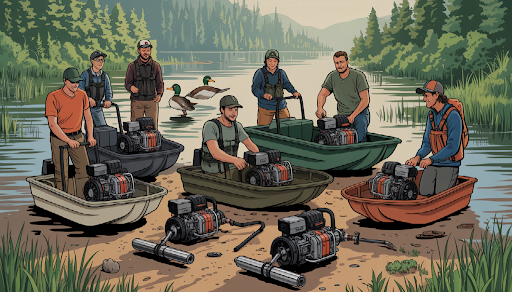
Shallow water navigation has undergone a quiet revolution over the past decade. Long tail mud motor kits—once a niche solution for hunters and fishermen in the American South—have evolved into a broader market segment that’s reshaping how outdoor enthusiasts approach inaccessible waterways. These kits transform conventional boats into specialized machines capable of traversing marshlands, weed-choked bayous, and waters barely deep enough to float a kayak.
The shift reflects broader changes in outdoor recreation. As accessible fishing spots become crowded and hunting pressure increases on public lands, adventurers are pushing into more remote terrain. That migration has created demand for equipment that can handle conditions where traditional outboard motors fail. The result is a growing ecosystem of manufacturers, DIY builders, and specialty retailers serving a market that barely existed twenty years ago.
Anatomy of a Specialized Motor System
Long tail mud motors operate on a fundamentally different principle than conventional outboards. Rather than submerging the entire lower unit, these systems use an extended shaft—sometimes exceeding six feet—that positions the propeller well behind and below the boat. This configuration allows the motor to push through vegetation and operate in water depths that would ground a standard motor.
The core components include:
- Engine: Typically air-cooled units ranging from 8 to 35 horsepower, often repurposed from industrial applications.
- Extended shaft: Steel or aluminum construction designed to withstand impact with submerged obstacles.
- Propeller assembly: Oversized blades engineered to move water efficiently while shedding debris.
- Mounting frame: Reinforced structure that distributes engine torque across the transom.
- Steering mechanism: Tiller or remote systems that control both direction and trim angle.
The extended shaft design reduces the risk of propeller damage in debris-filled waters by up to 70% compared to traditional lower units. This durability has made the technology particularly attractive in commercial applications, from wildlife management to coastal restoration work.
The DIY Movement Gains Momentum
The rise of do-it-yourself mud motor assembly represents one of the more interesting developments in the market. What began as backyard engineering projects in Louisiana and Arkansas has evolved into a legitimate segment, with manufacturers now offering complete kits designed for home assembly.
The appeal extends beyond simple cost savings:
- Customization: Builders can select engine sizes, shaft lengths, and propeller configurations matched to specific waterways and boat designs.
- Mechanical literacy: Assembling a motor from components provides intimate knowledge of the system, making field repairs more feasible.
- Economic access: Entry-level kits start around $1,200, compared to $3,000-plus for factory-assembled units.
- Community knowledge: Online forums and regional clubs have created extensive documentation of builds, modifications, and troubleshooting.
The DIY approach does require realistic assessment of mechanical skill and available tools. Popular Mechanics recommends that first-time builders have access to basic metalworking equipment and a solid understanding of small engine mechanics before attempting assembly. Long-tail mud motor kits from brands like Swamp Runner and Mud Skipper have become popular entry points for DIYers, but for those ready to take on the project, options like complete DIY kits from Beaver Dam Mud Runners provide all necessary components with detailed assembly instructions.
Surface Drive Technology and Its Applications
Surface drive systems represent a parallel evolution in shallow water propulsion. Unlike long tail designs that position the propeller below the waterline, surface drives use partially submerged propellers that create thrust through a combination of water displacement and air entrainment. The technology excels in extremely shallow conditions—some units operate effectively in as little as three inches of water.
Key advantages include:
- Ultra-shallow operation: Access to waterways impassable even for long tail motors.
- Reduced fouling: The propeller’s position above most vegetation minimizes entanglement.
- Obstacle clearance: Ability to tilt the drive unit over submerged logs and other hazards.
- Efficiency in specific conditions: Superior performance in mudflats and extremely weedy environments.
The technology has found particular favor among waterfowl hunters who need to access remote marshes during low-water periods.
Practical Considerations for Buyers
Selecting appropriate equipment requires matching motor characteristics to specific use cases. A system optimized for duck hunting in Arkansas rice fields will differ substantially from one designed for fishing Florida’s Everglades backcountry.
Critical factors include:
- Horsepower requirements: Determined by boat weight, typical load, and desired speed—underpowered systems struggle in current, while excessive power complicates handling in tight spaces.
- Shaft length: Must provide adequate propeller depth while maintaining proper trim angle; too short causes cavitation, too long creates excessive drag.
- Propeller selection: Blade pitch and diameter affect acceleration, top speed, and ability to shed vegetation.
- Mounting compatibility: Transom height and construction must accommodate the motor’s weight and torque.
- Operational environment: Saltwater use requires corrosion-resistant materials and more frequent maintenance.
Weight distribution deserves particular attention. Adding 80-150 pounds to the stern affects boat handling, especially in smaller hulls. Some operators install ballast forward or modify seating positions to maintain proper trim.
Market Dynamics and Regional Variations
The mud motor market shows distinct regional characteristics. Southern states—particularly Louisiana, Arkansas, Texas, and Mississippi—account for the majority of sales, driven by extensive shallow water habitat and strong hunting traditions. However, adoption is spreading to northern states with significant wetland acreage and to coastal areas where tidal flats create similar navigation challenges.
Pricing structures vary considerably:
- Entry-level kits: $1,200-$2,000 for basic DIY packages requiring assembly and engine sourcing.
- Mid-range systems: $2,500-$4,500 for complete units with smaller engines.
- Premium models: $5,000-$8,000+ for high-horsepower systems with advanced features.
- Custom builds: $10,000+ for specialized applications with unique requirements.
The used market has matured alongside new sales, with well-maintained units retaining 60-70% of original value after three years of moderate use. This residual value makes the technology more accessible to budget-conscious buyers willing to purchase secondhand equipment.