
Imagine preparing five PET bottles from a single production set, only to find that each sample looks different after cutting. One section is wider, another is crushed and a third has rough edges. Now the results are difficult to compare and the test may need to be repeated.
That’s the problem with poor sample preparation. Your testing tools may be accurate, but the result can still be unpredictable when bottle sections differ. A hot wire bottle cutter creates cleaner, more consistent samples, so quality checks start with a reliable base.
In this guide, you will learn what the common challenges in PET bottle sample preparation are and how a hot wire bottle cutter solves them:
Why Accurate PET Bottle Sample Preparation Matters
PET bottle testing is not only about checking the finished bottle. You also need to know how material is distributed across the neck, shoulder, body and base.
With sectional weight testing, you can see whether too much or too little plastic is sitting in a particular zone. It helps with quality control, production tuning and product development, though only if everything is cut correctly. The data is useful only when every section is cut correctly.
That’s where a hotwire plastic bottle cutter comes in; it offers more control than knives, scissors or the improvised tools people sometimes use.
Common Challenges During PET Bottle Cutting
Preparing PET bottle samples may look simple, but small errors can affect the results.
Uneven Sections
When you cut bottles by hand, it is easy to move away from the marked line. Even a small difference in section size can change the weight comparison.
Bottle Deformation
PET walls are thin and flexible. Too much pressure can crush or bend the bottle during cutting. Once its shape changes, separating the required areas accurately becomes harder.
Operator-to-Operator Differences
One technician may work faster, while another may apply more force. These changes create different samples, even when both people test bottles from the same batch.
Slow Preparation and Rework
Poorly cut samples often need to be discarded. That means more bottles, more technician time and a longer testing process.
Common problems include:
- Rough or uneven edges
- Sections with different widths
- Crushed bottle walls
- Repeated cutting and sample waste
- Safety risks from sharp tools
How a Hot Wire Bottle Cutter Solves These Problems
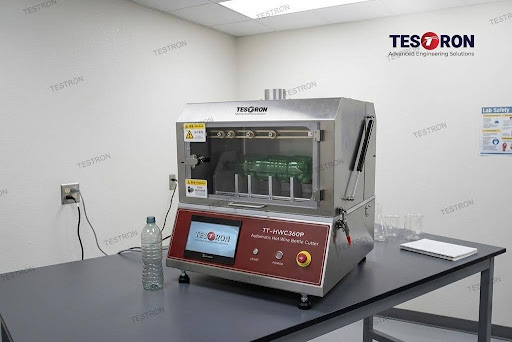
A hot wire bottle cutter is a specialised quality control machine that uses heated wires to separate PET bottles at specific points. Rather than pushing a blade through plastic, the system uses controlled heat for a smoother cut. It positions the bottle correctly and prepares several sections in one cycle. With adjustable wire placement, you can set cutting points for your laboratory method.
A hot wire PET bottle cutter reduces the impact of operator pressure. Your technicians do not need to force a knife through the bottle, thereby reducing the risk of crushing or distorting the sample.
The TT-HWC360P Automatic Hot Wire Bottle Cutter uses four parallel heating wires and can divide one bottle into up to five sections. Its adjustable cutting speed and heating power help you work with different bottle designs and material thicknesses.
This hot wire bottle cutter machine also includes a stable bottle support, automatic power disconnection and a smoke hood. Together, these features support a safer and more organized preparation method.
Manual or Automatic Bottle Cutting: What Changes?
Manual and automatic bottle-cutting procedures can both prepare samples, but they differ significantly in consistency, speed and operator involvement.
| Comparison Point | Manual Bottle Cutting | Automatic Hot Wire Bottle Cutter |
| Cutting consistency | Depends heavily on the technician’s skill | Delivers more controlled and repeatable cuts |
| Sample preparation speed | Slower when preparing multiple bottles | Faster for regular or high-volume testing |
| Operator involvement | Requires continuous hand control | Reduces manual handling during cutting |
| Risk of bottle deformation | Higher due to uneven force or pressure | Lower because controlled heat separates the bottle |
| Section accuracy | May vary between technicians | Helps produce matching sections across samples |
| Best suited for | Occasional sample preparation | Routine laboratory and production testing |
When comparing a manual hot wire bottle cutter and an automatic hot wire bottle cutter, consider your sample volume, required repeatability, workload and operator safety. Automation is especially useful when you need consistent section sizes across multiple bottles and production batches.
Choosing the Best Hot Wire Bottle Cutter for Your Laboratory
The best hot wire bottle cutter should match your bottle size, testing volume and preparation method. You should not choose a system only because it has the lowest quotation.
Check these points before making a decision:
- Maximum bottle diameter and height
- Number of sections produced per cycle
- Adjustable wire positions
- Cutting speed and heat control
- Bottle support and stability
- Smoke-control features
- Safety shut-off functions
- Spare-wire availability
- Warranty and technical support
When checking the best hot wire bottle cutter price, also consider long-term value. A dependable system can reduce the number of rejected samples, technician time and repeated testing.
Why Your Manufacturer and Supplier Matter
Your choice of equipment is also a service decision. A dependable hot wire bottle cutter manufacturer should help you understand the machine, its settings and whether it suits your bottle formats.
A reliable hot wire bottle cutter supplier should offer product guidance, after-sales support, spare parts and help as your needs change. By working with a reliable team, you can explore quality-control and material-testing equipment designed for packaging companies, testing laboratories and production teams.
Reliable PET bottle testing really starts with nailing the sample preparation and then it continues with the same quality-focused method that shows up across the packaging industry. If you require more detail about PET as a packaging material, the U.S. Environmental Protection Agency (EPA) has useful data on packaging plastics and recycling.
Achieve Faster, More Accurate PET Bottle Sample Preparation
Accurate results begin with accurate preparation. The right cutting system can reduce sample damage, improve consistency and make sectional weight testing more dependable.
Request a demo from Testron Group and discover how the TT-HWC360P can support faster, safer and more reliable PET bottle testing.