
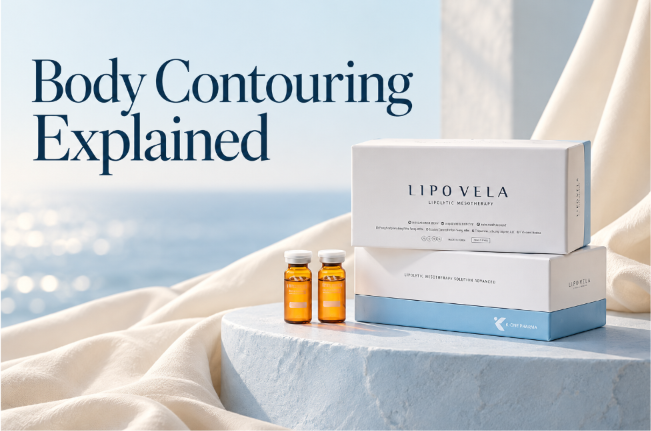
Editorial illustration based on product imagery.
Body contouring can sound simple when it is presented as a way to dissolve a stubborn area of fat. The decision is more specific than that phrase suggests. The cause of the visible concern, the exact product or device, the treatment area, and the evidence all matter. A smaller-looking area is not the same goal as weight management, firmer skin, or a change in cellulite.
Lipo Vela is marketed internationally as a fat-dissolving solution. For U.S. readers, a significant fact belongs at the beginning: a March 2025 FDA warning letter to a different seller explicitly included Lipo Vela among products marketed as unapproved new drugs. That letter was not addressed to FillersFairy, and it should not be represented as such. It does mean that the product should not be described here as an FDA-approved contouring option. [1]
This guide uses the product as a starting point for understanding body-contouring claims and comparing appropriate professional assessments. It does not recommend purchasing or self-injecting Lipo Vela. The practical goal is to help readers ask better questions before committing to an elective procedure.
Identify the Feature You Want to Change
Begin with a description of the area and the change you hope to see. A soft bulge, loose skin, dimpling, and a concern about overall body size can look related but lead to different discussions. A clinician needs to assess the area rather than selecting a treatment from a photograph or a product advertisement.
Ask whether the concern is primarily localized fat, skin laxity, another structural feature, or a combination. A procedure intended to reduce fat does not automatically tighten skin or improve every type of surface irregularity. If several issues are present, the provider should explain which one the proposed intervention is expected to address.
Keep the goal proportionate. You may want clothing to fit differently or a profile to look slightly changed. Those are more useful starting points than asking for a perfect body shape. A provider should help translate the preference into a realistic discussion without treating normal anatomy as a defect that requires correction.
The option of no procedure belongs in that discussion. Elective contouring is a personal choice, not an obligation. If the likely change is smaller than you would consider worthwhile, declining treatment is a reasonable decision. A clear assessment should make that choice easier to evaluate.
What the Lipo Vela Listing Establishes
The Lipo Vela 10ml listing identifies a package of ten 10 mL units and describes a formulation associated with phosphatidylcholine and deoxycholate. These are statements about how the seller presents the product. They do not independently establish ingredient concentration, clinical superiority, or a safe treatment plan for a particular person.
Package size should not be interpreted as a treatment course. Ten units in a box does not mean ten visits are appropriate, and the volume of a container does not establish the amount suitable for any body area. A product article should not infer clinical directions from a commercial presentation.
The phrase fat dissolving can also obscure important distinctions. A mechanism attributed to an ingredient does not establish the safety or effectiveness of every finished product containing it. Manufacturing, formulation, route, and clinical evidence remain relevant. An approved product’s evidence cannot simply be transferred to another brand.
For that reason, this article does not provide injection depths, amounts, patterns, mixing directions, or a session schedule. Those details would create the appearance of a validated protocol where the necessary product-specific basis has not been established. The useful next step is professional assessment and an evidence-based comparison of locally appropriate options.
Know the US Approval Boundary
FDA consumer guidance identifies Kybella, a deoxycholic acid product, as the approved fat-dissolving injection for reducing moderate to severe submental fullness in adults. Its approval does not extend to every body area or to other products that contain related ingredients. The exact drug and indication are essential to the statement. [2]
An international website may describe uses across the abdomen, arms, hips, or other areas. That description does not demonstrate FDA approval for those uses. Nor does a claim that a product is used professionally resolve the question. Ask for the specific authorization and current labeling rather than a general assurance.
In September 2026, the FDA also announced additional Kybella labeling information concerning adverse reactions associated with unapproved uses. The communication discusses injection-site nodules and masses, including cases that may require medical intervention. This reinforces the importance of using current information and not assuming that a familiar ingredient removes procedural risk. [3]
Regulatory status is not the only consideration, but it is an important part of an accurate comparison. A reader should not leave a lifestyle article believing that all marketed fat-dissolving solutions are equivalent alternatives within the same approved category. The evidence and authorization need to remain attached to the exact product.
Compare Procedures by Their Actual Purpose
Body-contouring options differ in how they work, what they are intended to change, and what burdens they impose. The FDA explains that non-invasive body-contouring devices are evaluated for specified uses and body sites. Device-based treatment is also distinct from surgical procedures such as liposuction or removal of excess skin. [4]
The American Society of Plastic Surgeons describes liposuction as a surgical approach to removing excess fat from specific areas. Candidacy includes an individualized assessment and realistic goals. It should not be presented as a general treatment for obesity or a universal answer to loose skin. [5]
A comparison should therefore start with the problem, not with which method sounds least invasive. An option with a lighter recovery burden may offer a more limited result. A more involved procedure may still be inappropriate for a particular person. The clinician should explain the tradeoff in relation to your goal.
| Option | Main discussion | Limitation to clarify |
|---|---|---|
| No procedure and observation | Whether the concern warrants intervention | No procedural change is expected |
| Medical weight-management care | Overall health and weight-related goals | Different purpose from a localized cosmetic procedure |
| Authorized contouring device | Product-specific treatment of a defined area | Results and risks vary by device and indication |
| Kybella where appropriate | Labeled adult submental-fat indication | Approval does not transfer to other products or body areas |
| Liposuction consultation | Surgical removal of localized fat | Surgery, recovery, and candidacy require assessment |
| Skin-removal or tightening assessment | Whether laxity is the main concern | Fat reduction alone may not address excess skin |
Distinguish Fat Reduction from Weight Management
If the goal is a major change in body weight or a health concern associated with weight, a cosmetic contouring consultation may not be the right starting point. Ask a qualified medical professional which assessment is appropriate. A treatment aimed at a localized area should not be marketed as solving the broader medical question.
Likewise, a stable body weight does not automatically make every person a candidate for contouring. Anatomy, skin condition, health history, and expectations still matter. A provider should explain why a particular intervention fits the area rather than relying on a single number or a visual impression.
Avoid judging success only by the scale. A localized cosmetic goal and a weight-management goal use different outcomes. If the clinic promises one while measuring the other, the comparison becomes confusing. Agree on how the proposed change will be assessed and what would count as a meaningful result.
This distinction can also reduce pressure. Someone seeking help with health or body image should not be pushed toward a cosmetic package because it is easy to sell. A respectful consultation identifies the real concern and discusses the appropriate next step, including referral or a decision to defer.
Ask What the Evidence Actually Measured
A claim of improved contour should identify the treated area and the way change was assessed. Photographs, circumference measurements, imaging, and patient satisfaction do not provide identical information. Each has limitations that should be explained before a percentage is used to promote a treatment.
Ask whether a study examined the exact product. Research on deoxycholic acid in a particular approved formulation does not prove that a phosphatidylcholine-containing mixture has the same effect. Evidence about a different body site may also be insufficient for the proposed use.
Look at the observation period. An early image may reflect swelling or a temporary change. A later result is relevant to durability only if follow-up is adequately described. A promise of permanence should not be inferred from a short observation window or a theoretical mechanism.
A direct comparison requires comparable participants, areas, outcomes, and assessment times. If those conditions differ, a ranking based on separate studies may be misleading. It is acceptable for a clinician to say that a reliable head-to-head answer is not available. That answer is more useful than an unsupported winner.
Understand Risks in Plain Language
Unapproved fat-dissolving injections can cause harm. FDA consumer information describes reports including serious infections, scarring, skin deformities, cysts, and painful knots. The agency also warns against purchasing products online for self-injection. These are reasons to seek qualified care and verified information, not instructions for making an unapproved procedure safer at home. [2]
Approved treatments also have risks. Kybella labeling includes concerns such as nerve injury and difficulty swallowing, among other adverse reactions. A clinician should explain the relevant risks in the context of the actual product and indication. Do not interpret approved as meaning appropriate for everyone or free of complications. [6]
Ask what symptoms require urgent attention and how the clinic handles concerns outside normal hours. Severe pain, rapidly worsening redness, fever, skin breakdown, breathing difficulty, or trouble swallowing after a procedure warrant prompt medical evaluation. The precise response depends on the symptoms; an online article cannot assess an individual complication.
If you have already received an unfamiliar injection, tell the evaluating clinician exactly what was used if you know. Bring the package, treatment record, or photographs of the label. Do not repeat treatment or attempt to manage a suspected complication through advice from an online seller or a social-media group.
Choose a Consultation That Allows Questions
A useful consultation begins with an examination and medical history. The provider should ask about your health, medications, prior procedures, and the change you want. A recommendation made before those questions are addressed is missing essential context.
Ask about the professional’s qualifications and experience with the proposed procedure. Verify the relevant license and credentials through the appropriate authority. A social-media following or a polished clinic interior does not establish competence, and a training certificate should be interpreted in relation to the person’s professional role.
Ask who would evaluate a complication and whether the practice has an appropriate escalation plan. The answer should be practical: a named role, a contact route, and an explanation of what happens if more advanced care is needed. A vague promise that complications never happen is not reassuring.
Take time to review the information. Elective treatment rarely needs to be decided because a discount expires that afternoon. A provider who allows time for reflection gives you a better opportunity to compare alternatives and determine whether the likely benefit is worth the burden.
Build a Complete Cost Comparison
Compare the proposed course of care, not just the price of one vial or one session. Include the consultation, procedure, planned reviews, possible maintenance, and time away from usual activities. Ask whether management of an unexpected concern is included or billed separately.
Clarify the basis for the number of sessions. The provider should connect the plan to the treatment and assessment rather than to the size of a promotional package. A higher number of visits does not automatically mean a more thorough or more effective approach.
Consider the cost of an uncertain result. If the expected change is modest, would you still consider the expense worthwhile? Ask what the clinic would recommend if the goal is not met and whether that recommendation would involve additional fees. These questions are easier to discuss before payment.
For commercial product literacy, aesthetic treatment products can be browsed to understand the names used in the market. Keep that information separate from the decision to undergo treatment. This link is not a recommendation to buy Lipo Vela or another injectable for personal use.
Read Photographs with a Critical Eye
Body-contouring photographs are especially sensitive to posture, lighting, clothing, and camera position. A small change in how someone stands can alter the apparent contour. A useful comparison should keep those conditions consistent and state the interval between images.
Ask whether other changes occurred during the same period. Weight change, additional procedures, and different styling can affect the apparent result. A photograph may show a real improvement without establishing which intervention caused it. That limitation should remain visible in the explanation.
Be cautious about a gallery containing only the most dramatic examples. It does not show the range of outcomes or the proportion of people who did not achieve a meaningful change. Ask the provider what a typical result looks like in someone with a comparable starting concern.
Your own photographs should be used for a defined review, not for constant scrutiny. Agree on a reasonable observation plan with the clinician. Repeatedly comparing your body with edited online images can make a modest elective concern feel more urgent than the clinical situation warrants.
Three Different Concerns Can Require Three Different Conversations
Consider three hypothetical readers. The first describes a small area of fullness and otherwise feels comfortable with their shape. The second is mainly bothered by loose skin after a substantial body change. The third wants a major reduction in overall body size. These examples are illustrations, not patient cases.
The first reader needs an assessment of the local anatomy and a discussion of realistic contouring options. The second needs clarification about skin laxity and whether fat reduction would address the concern at all. The third may need a medical weight-management conversation rather than a cosmetic product comparison.
None of those pathways can be chosen from a product name alone. The same advertisement may attract all three readers, but an appropriate consultation should separate their goals. This is why the phrase stubborn fat is too broad to determine a treatment plan.
Use the examples to prepare your own description. State what you notice, what change matters, and what you would consider an acceptable burden. The clinician can then assess whether the proposed procedure addresses the concern or whether another route would be more appropriate.
Plan for the Practical Burden of an Elective Procedure
A realistic contouring decision includes the demands on your schedule. Ask the treating clinician how the proposed procedure could affect work, exercise, travel, and important events. The answer should relate to the actual intervention and your circumstances, rather than rely on a broad promise that all nonsurgical treatments have no downtime.
Consider who can help if you need transportation or support afterward. Clarify how follow-up appointments will fit into your calendar and what you should do if recovery differs from the expectation discussed. These arrangements do not establish that a procedure is appropriate, but they make an appropriate plan easier to carry out responsibly.
Avoid setting a deadline that encourages decisions before the clinical assessment is complete. An approaching wedding or vacation can make a promotional package feel urgent even when the body concern has been present for years. Tell the clinician about the event so expectations can be discussed honestly, including the possibility that treatment should be deferred.
Your budget should include these practical costs as well as the quoted procedure fee. Time away from work, travel for review, and support at home can matter to the overall choice. A useful comparison makes those assumptions visible instead of describing one option as cheaper based only on the initial appointment.
Use a Body Contouring Decision Note
Before the consultation, write a short statement describing the feature you want to change and the improvement you would consider worthwhile. Keep it specific enough that you and the clinician can revisit it later. A statement about a particular contour is more useful than a general desire to look completely different.
During the visit, add the clinician’s explanation of what contributes to that feature. Ask whether the proposed procedure addresses that explanation and what it is unlikely to change. This step can reveal a mismatch between an advertisement for fat reduction and a concern that involves skin laxity or another factor.
Record the alternatives discussed, including no procedure. For each option, note the expected benefit, major limitations, and practical burden. You do not need to assign numerical scores unless they help you think; the value lies in making the reasoning explicit.
Afterward, read the note away from the sales conversation. Identify any claim that still needs clarification, particularly a promise of permanence, guaranteed inches lost, or a universally suitable treatment. Ask the clinician for a relevant source and an explanation of how it applies to you.
The completed note is not medical consent or a treatment protocol. It is a personal decision aid that helps you recognize whether the proposal matches your own priorities. If the explanation remains unclear, another consultation is a reasonable next step before committing to an elective intervention.
Frequently Asked Questions
Is Lipo Vela FDA approved for body contouring
The FDA warning letter cited in this article included Lipo Vela among products marketed as unapproved new drugs. It was issued to another seller, not FillersFairy. This article does not identify an FDA approval for Lipo Vela and does not recommend it as a U.S. body-contouring treatment. Ask for authoritative product-specific documentation if any provider claims otherwise.
Is Lipo Vela the same as Kybella
No. A shared or related ingredient does not make two finished products equivalent. Kybella has specific U.S. labeling and a defined adult submental-fat indication. Its evidence and approval should not be transferred to Lipo Vela or another marketed mixture. Compare the exact product, formulation, indication, and regulatory record rather than the general phrase fat dissolving.
Can a fat reduction procedure tighten loose skin
Do not assume that it will. Skin laxity and localized fat are different features, and the appropriate approach depends on examination. Ask the clinician to explain which component of your concern the proposed treatment addresses. If excess skin is central, a separate assessment may be needed, and reducing fat alone may not produce the result you want.
Is a nonsurgical treatment automatically low risk
No. Nonsurgical describes the absence of a surgical operation, not the absence of possible harm. Injections and devices have their own risks, and those risks depend on the exact treatment and individual circumstances. Ask for a balanced explanation of likely short-term effects, serious complications, alternatives, and the plan for prompt assessment if a concern develops.
Can I judge the needed treatment from the number of vials in a box
No. Packaging does not establish an appropriate amount, treatment area, or course. Those are clinical questions, and an online package description cannot answer them. Do not use a product listing to plan self-injection or to compare procedures by how many containers you can buy for the same price.
What should I ask before paying a deposit
Ask for the exact product or device, the intended area and goal, applicable authorization, evidence, expected limitations, and follow-up arrangements. Clarify the total cost and the policy if the clinician decides treatment is inappropriate. You should understand the proposed plan in ordinary language and have time to consider it without pressure from a short-lived promotion.
What if I have already had a reaction after an injection
Seek medical assessment and provide the product and treatment information you have. Urgent or worsening symptoms should not wait for a routine cosmetic review. Avoid repeating the treatment or trying to correct it yourself. The evaluating clinician needs to assess the actual symptoms and circumstances rather than relying on a generic online description of normal recovery.
Choose an Assessment before a Contouring Package
Write down the feature you want to change and book a consultation with an appropriately qualified clinician. Ask them to distinguish localized fat, skin laxity, and broader weight-related goals, then explain the locally appropriate options. A sound decision should be based on a defined concern and credible evidence, with enough time to decide whether any procedure is worthwhile.
References
- U.S. Food and Drug Administration. Julian Naya Beauty LLC Warning Letter MARCS CMS 699782. March 3, 2025.
- U.S. Food and Drug Administration. Using Fat Dissolving Injections That Are Not FDA Approved Can Be Harmful. Consumer guidance.
- U.S. Food and Drug Administration. FDA Approves Additional Information in Labeling for Kybella Deoxycholic Acid Injection Warning of Adverse Reactions Associated with Unapproved Use. 2026.
- U.S. Food and Drug Administration. Non Invasive Body Contouring Technologies. Consumer and professional information.
- American Society of Plastic Surgeons. Liposuction Candidates. Patient education.
- U.S. Food and Drug Administration. KYBELLA Deoxycholic Acid Injection Prescribing Information. 2026 labeling.
- American Academy of Dermatology. Non Invasive Fat Removal What Can You Expect. Patient education.
Sources checked October 10, 2026. Educational discussion; no injection instructions or endorsement of unapproved fat-dissolving products is provided.