
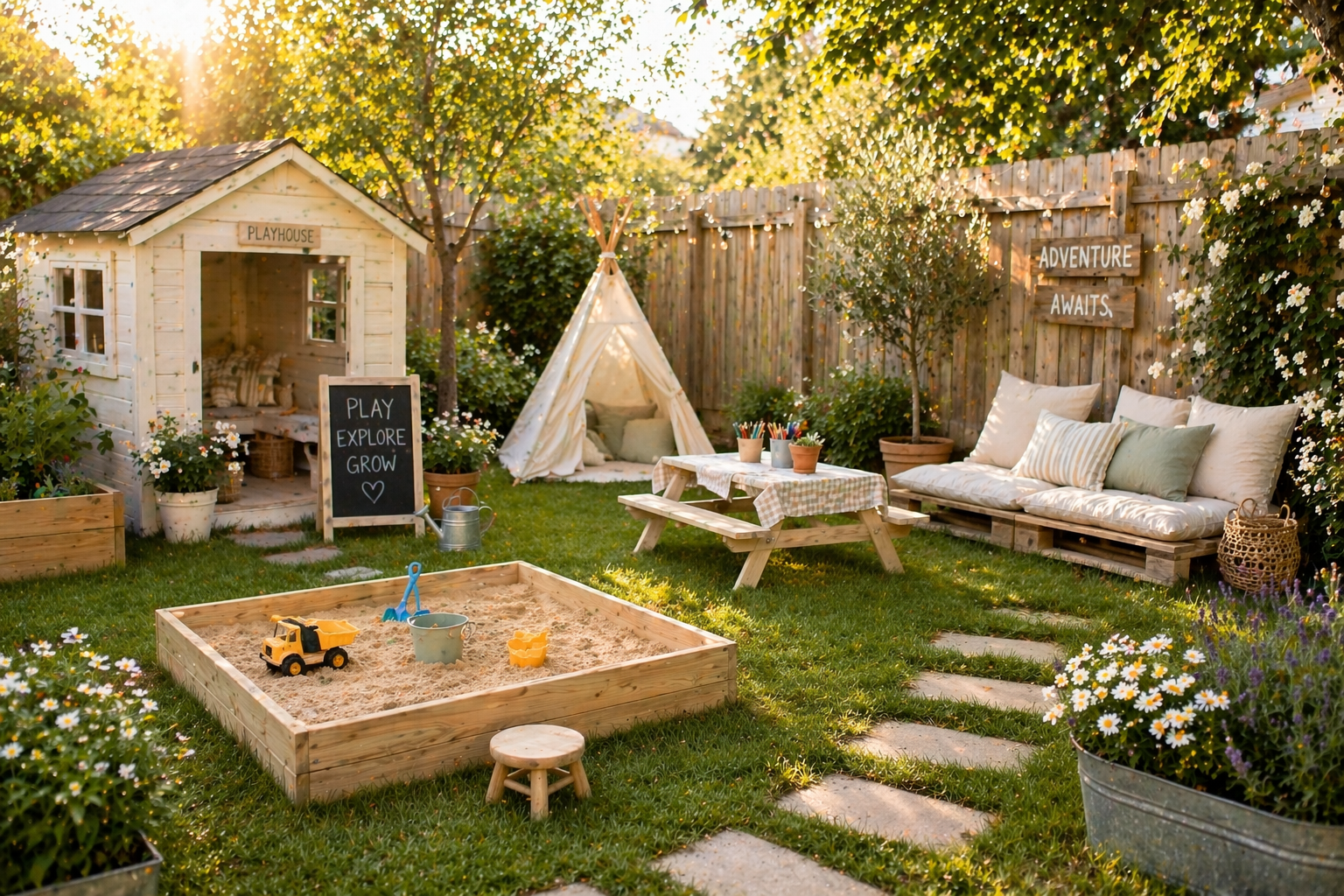
Most parents want a garden their children actually use. But it is easy to spend a lot of money and still end up with a space that nobody plays in.
The good news is that a great play space does not need to be big or expensive. It just needs to be planned properly. In this article, we will explain how to set up your garden, what to buy, what to skip, and how to keep it looking nice at the same time.
Why planning comes first
Many people start by buying something big. A climbing frame, maybe, or a trampoline. Then they try to fit it into the garden.
This is the wrong way round. It is much better to plan the space first and then choose what goes in it. That way, everything fits and nothing is wasted.
What zones should your garden have?
The best play gardens are split into areas. Three is usually enough.
The active area. This is for climbing, swinging and running. Put it at the far end of the garden, away from the house. It is safer and a little quieter.
The messy area. This is for water play, sand, mud kitchens and painting. Keep it near a tap and on a surface you can wash down.
The quiet area. This is for dens, reading and hiding. It costs almost nothing. A corner behind some plants is enough. Children use this area far more than people expect.
How much space should equipment take up?
Here is a simple rule. No single item should take up more than a third of your usable lawn.
The space around outdoor play equipment matters just as much as the equipment itself. Children need room to run, chase and play games around it. A big frame squeezed between two fences will be used far less than a small one with space around it.
Also think about the future. Will your child still want this in five years? Equipment with removable bars or swappable parts lasts much longer. Otherwise you may be replacing it all again in a few years.
Are expensive toys worth it?
Often, no.
Simple things get played with the most. A box of logs, planks, buckets and old pots will keep children busy for hours. Children love making things up, and open-ended items let them do that.
This is why a good set of outdoor toys can be better value than another big structure. Balls, chalk, water pistols, a paddling pool and a bug-hunting kit all cost very little. They also store away easily.
Try rotating them. Put some away for a few weeks, then bring them back out. Children treat them like new again.
Where should you keep everything?
This part gets forgotten a lot.
Without storage, toys live on the grass. The lawn dies and the garden looks messy. A storage bench, a small shed or a waterproof box against the wall will solve it.
Pick something your children can open themselves. Then tidying up becomes their job too.
What about mud?
Grass and children do not mix well in winter. By February, most lawns under a swing are gone.
You have a few options:
- Bark chips. Good under climbing equipment. They look natural and soften falls.
- Artificial grass. Solves mud completely, but it gets hot in summer and does not drain well in heavy rain.
- Accept it. Keep real grass in one part of the garden and give up on the patch under the swing.
Most families end up with a mix of all three.
How do you keep it looking like a garden?
A garden can be fun for children and still look good. Here is how.
Choose wooden equipment instead of bright plastic where you can. It blends in better and weathers well.
Use plants to hide things. A shrub in front of a climbing frame makes a big difference.
Plant around the edges. Tough plants and grasses will survive the odd football.
Keep garden lighting separate from the play area, so the space still feels calm in the evening.
Should you finish it all at once?
No. This is one of the biggest mistakes.
Children change quickly. What a four year old loves, an eight year old ignores. A garden that can be changed and added to will last much longer than one built in a single weekend.
Start small. Add things slowly. Leave space for what comes next.
Final thoughts
A great outdoor play space is not about spending the most money. It is about planning the zones, leaving room to move, choosing simple toys, and adding storage.
Do those four things and your children will use the garden all year.