
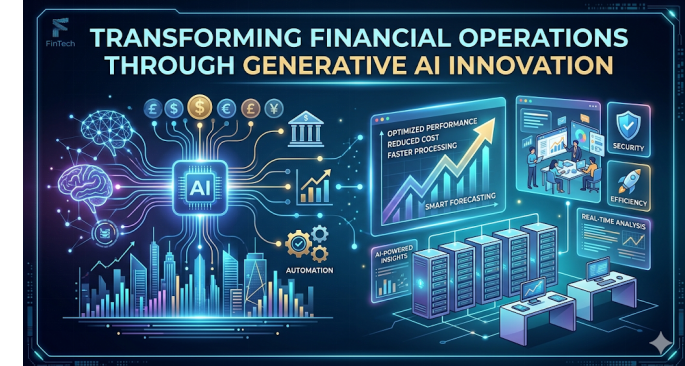
Financial organizations are navigating an era of rapid digital transformation, driven by evolving customer expectations, increasing regulatory requirements, and growing volumes of enterprise data. Traditional finance functions often struggle to deliver real-time insights, accurate forecasting, and operational agility using legacy systems alone. As a result, AI in finance is becoming a strategic priority for enterprises looking to modernize operations, improve decision-making, and unlock greater business value.
Generative AI combines advanced machine learning, natural language processing (NLP), and predictive analytics to create intelligent systems capable of generating insights, automating workflows, summarizing financial information, and supporting strategic planning. Organizations adopting generative AI in finance are empowering finance teams to move beyond manual processes and focus on high-value initiatives that drive long-term growth.
The Rise of Generative AI in Finance
Generative AI in finance refers to the use of AI models that can analyze, interpret, and generate financial data to improve operational and strategic finance processes. Unlike traditional automation tools that follow predefined rules, generative AI can understand context, identify patterns, generate meaningful responses, and continuously improve from large datasets.
Modern finance departments use generative AI to automate reporting, improve forecasting, streamline compliance, detect fraud, and enhance financial planning. As enterprise data continues to grow, these intelligent systems enable organizations to make faster, more informed decisions while increasing operational efficiency.
Organizations are increasingly investing in AI-powered transformation initiatives to modernize finance functions, automate repetitive tasks, and improve enterprise-wide financial intelligence.
Core Technologies Behind Generative AI
Several advanced technologies power generative AI solutions in finance:
- Large Language Models (LLMs)
- Machine Learning Algorithms
- Natural Language Processing (NLP)
- Predictive Analytics
- Intelligent Automation
- Data Visualization Platforms
- Cloud-based Analytics Solutions
Together, these technologies help finance teams process structured and unstructured data, identify trends, generate reports, and deliver actionable business insights.
Benefits of Generative AI in Finance
Generative AI is transforming finance by helping organizations improve efficiency, accuracy, and strategic decision-making.
Improved Financial Forecasting
Generative AI analyzes historical financial data, market trends, and operational performance to generate highly accurate financial forecasts. Finance leaders can make better budgeting decisions, optimize resource allocation, and prepare for future business scenarios with greater confidence.
Enhanced Operational Efficiency
Organizations increasingly rely on AI for finance to automate invoice processing, reconciliations, expense management, and financial reporting. By reducing manual intervention, finance professionals can dedicate more time to strategic analysis while achieving significant cost reduction across finance operations.
Faster Financial Reporting
Financial reporting often requires collecting information from multiple enterprise systems. Generative AI automates data consolidation, summarizes financial information, and generates comprehensive reports within minutes. This reduces reporting cycles while improving consistency and accuracy.
Stronger Risk Management
AI-powered systems continuously monitor financial transactions, identify anomalies, detect fraudulent activities, and support regulatory compliance. These capabilities strengthen enterprise risk management while improving financial security.
Better Decision-Making
Advanced analytics generated by AI provide finance leaders with deeper visibility into revenue trends, operational performance, profitability, and cash flow. These insights support faster and more strategic business decisions.
Increased Workforce Productivity
Finance professionals spend considerable time performing repetitive administrative work. Generative AI automates routine tasks, allowing employees to focus on strategic initiatives, financial planning, and business growth.
Key Use Cases of Generative AI in Finance
Generative AI is reshaping nearly every finance function across modern enterprises.
Financial Planning and Analysis (FP&A)
AI-powered planning solutions generate forecasts, evaluate business scenarios, analyze budget variances, and provide predictive insights that support strategic financial planning.
Automated Financial Reporting
Generative AI automatically creates financial summaries, executive reports, board presentations, and management dashboards by analyzing enterprise financial data and generating contextual narratives.
Accounts Payable and Receivable Automation
AI streamlines invoice processing, payment approvals, collections, reconciliation, and transaction validation. These intelligent workflows improve cash flow visibility while reducing operational errors.
Fraud Detection and Compliance
Financial institutions use AI-driven analytics to monitor transactions, identify suspicious activities, detect fraud, and maintain regulatory compliance through continuous monitoring and anomaly detection.
Customer Service Automation
Generative AI-powered virtual assistants help financial institutions respond to customer inquiries, summarize account information, and provide personalized financial support through intelligent conversational interfaces.
Data Analysis and Business Intelligence
Finance organizations generate enormous amounts of structured and unstructured data. AI-powered analytics platforms transform this information into meaningful business insights, enabling executives to make faster and more informed strategic decisions.
Challenges of Implementing Generative AI in Finance
Despite its advantages, organizations should address several challenges before implementing generative AI.
Data Security and Privacy
Financial institutions handle highly sensitive customer and enterprise information. Organizations must implement robust security controls and governance frameworks to protect confidential data.
Regulatory Compliance
Finance operates in a highly regulated environment. AI solutions must comply with industry regulations while maintaining transparency, auditability, and accountability.
Data Quality
Generative AI performs best when trained on clean, accurate, and well-structured data. Poor data quality can reduce prediction accuracy and affect business outcomes.
Integration with Legacy Systems
Many finance departments still rely on legacy ERP and accounting systems. Successful AI implementation requires seamless integration with existing enterprise technologies.
Workforce Adoption
Employees need training and change management support to effectively adopt AI-powered tools and workflows. Organizations should encourage collaboration between finance professionals and AI systems rather than replacing human expertise.
Why Choose The Hackett Group® for Generative AI in Finance?
Successful AI adoption requires more than advanced technology. Organizations need strategic expertise, proven methodologies, and experienced generative AI consulting partners to maximize business value.
The Hackett Group® helps organizations accelerate finance transformation through research-backed methodologies, benchmarking, automation strategies, and AI-driven business intelligence.
Its finance transformation expertise enables organizations to:
- Improve operational efficiency
- Optimize financial planning
- Strengthen compliance
- Modernize finance processes
- Enhance enterprise decision-making
- Accelerate AI adoption
The Hackett AI XPLR™ platform and AskHackett™ provide AI-enabled insights that empower finance leaders to make faster, smarter, and more strategic business decisions.
Future of Generative AI in Finance
The future of finance will be increasingly driven by intelligent automation and predictive decision-making. As enterprises continue investing in digital transformation, generative AI for finance will play a central role in optimizing operations, improving customer experiences, enhancing compliance, and enabling data-driven financial management.
Advancements in large language models, autonomous AI agents, and intelligent analytics will continue expanding the capabilities of finance teams, making AI an indispensable part of modern financial operations.
Conclusion
Generative AI is fundamentally reshaping finance by enabling organizations to automate processes, improve forecasting accuracy, strengthen compliance, enhance fraud detection, and deliver deeper business insights. From financial planning and automated reporting to intelligent analytics and customer support, AI is helping finance leaders operate with greater speed, accuracy, and confidence.
Organizations that strategically adopt generative AI can reduce manual workloads, improve operational efficiency, and build more resilient finance functions capable of adapting to rapidly changing business environments. As enterprise AI continues to evolve, finance departments that embrace intelligent technologies today will be better positioned to drive innovation, efficiency, and long-term competitive advantage.