
File name1: female-engineer-inspecting-precision-electronic-part.jpg
Introduction
Consumer electronics, telecommunications, and other advanced technology sectors are facing extreme challenges of miniaturization and high frequency. As product designs become increasingly complicated, they require almost perfect tolerances, great finishing of the surface, as well as excellent structural stability in terms of metals and plastics. Consequently, volatile yields, that are often less than 70%, significantly hamper the schedule of production and increase total development costs.
CNC milling service providers have difficulty in dealing with thin wall constructions, micro holes, and complex cavities. Some problems associated with too much tool vibration, deformation caused by heat during machining, and programming inefficiency prevent achieving micron-level accuracy and meeting strict deadlines simultaneously. Suppliers usually compromise on either accuracy or schedule, failing to fulfill requirements of the modern electronics R&D process.
This article explores a systematic solution that covers intelligent process parameter libraries, real-time thermal compensation technology, and fast changeover workflows. The approach stabilizes first-pass yield above 99% for precision electronic components and compresses critical part delivery to just 48 hours. Below, each core technology and strategy is examined in detail, helping manufacturers gain a competitive edge in today’s demanding market.
Why Is Micron-Level Tolerance the Biggest Obstacle for Electronics CNC Milling?
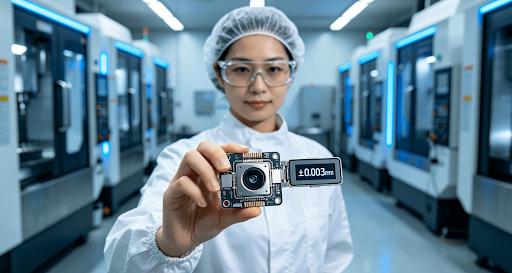
In the current world of electronics, products such as connectors for smartphones, camera units, and RF filters in 5G base stations, demand highly precise milling. PCB guide pins, for example, need tight tolerances such as ±0.005 mm, while some waveguides require even tighter tolerances. Existing mechanical machining cannot produce this degree of accuracy because there are several reasons why it is not possible, among which there is machine thermal drift from long operations, micro-deformation due to cutting force effect, and gradual wear of tools, changing their geometry.
The combination of thermal compensation technology and advanced vibration compensation system creates an ultra-stable system of cutting using special micro-tools. Temperature changes are monitored in different places of the machine construction, and axes movements are adjusted accordingly, making thermal errors disappear. Besides, adaptive vibration algorithms dampen the regenerative chatter, providing stable cutting in higher material removal rates. It means that this technology meets all requirements to produce components with tight tolerances and allows getting perfect fit and electrical performance.
Such systematic capability represents the core value of custom electronics machining services. By eliminating repeated trial cuts and reducing scrap, manufacturers can achieve consistent quality from the very first part. This high stability is also essential for realizing true on-demand manufacturing, where rapid response and zero-defect output are paramount. Without these technologies, attempts to push cycle times inevitably result in rejected parts and costly delays.
How to Reduce Heat Sink Lead Time by Half While Maintaining 0.02 mm Fin Thickness?
The standard aluminum electronic enclosure or heat sink possesses very thin fins, such as 0.8 mm in thickness and 15 mm in height. Such sensitive components are extremely vulnerable to vibration and deformation under normal machining procedures, which cause bad surface roughness and tolerance as well as possible breakages. The main idea is to apply a dynamic-path feed rate adjustment process, which allows the system to react to changing spindle loading conditions instantly. As a result of such an approach, structural and thermal properties will be maintained despite any cutting speed used.
Let us consider a practical example when 5G equipment manufacturer suffered from significant delays of their projects due to the reduction of heat sink yields up to 70%.Such significant progress proves that good industrial manufacturing provider can provide a quick-turn electronics machining and make a two-week project in two days.Besides the technological part, there should be cooperation between the supplier and client in DFM stage.
What Are the Essential Differences Between PCB Milling and Metal CNC Machining?
While both are subtractive methods of production, PCB milling involves removing copper foil to create circuit paths, while metal CNC milling involves the three-dimensional shaping of a solid material.
Basic Differences and Hazards
The PCB process needs to prevent any formation of burrs, lifting of copper layers, or dust particles that can lead to a circuit shorting. The metal machining process concentrates more on managing stress, heat, and chip removal. Using incorrect parameters may result in pad lifting on the PCB, or cracks on metal components.
Dedicated Protocol for Each Process
- PCB Milling Measures
Specialized carbide routers with specific flute geometries minimize burr formation. Vacuum tables secure panels while debris is removed via high-efficiency particulate air filtration.
- Metal CNC Milling Measures
Rigid setups, coolant delivery, and chip management prevent work hardening and heat buildup. This clear distinction ensures optimal performance for both PCB prototyping vs CNC milling requirements.
What Hidden Costs Should a Complete Precision CNC Machining Quote Include?
While many engineers concentrate on just unit pricing while asking for a CNC machining quotation, it should be noted that there are many other elements that affect overall project costs and which tend to be ignored. They consist of material qualification expenses (certification and tracing), the cost of special fixture design and fabrication, rush order expedited fees, and rework costs in case initial samples fail the check. Moreover, secondary operations like deburring, finishing, or assembly might not be considered in simple quotations.
The clear quotation approach is based on a well-designed parametric system that considers many technical aspects like ratios of deep cavities, small internal radii, materials that might be difficult to machine (for example, stainless steel that is known for its tendency to harden while aluminum alloys tend to stick to tools), as well as logistical aspects like surface finishing by external suppliers.
Professional CNC milling services providers always recognize the above risks and disclose them in their quotes.This eliminates budget surprises and demonstrates supplier expertise. Choosing a provider offering custom milling serviceshelps avoid common quotation traps from the outset. Furthermore, factories holding ISO 9001 and AS9100D certifications back their quotes with audited, stable processes—this documented quality assurance is the true source of long-term value, far outweighing any apparent upfront savings from less rigorous competitors.
How to Ensure Consistency of Every Batch of Electronic Parts Through Digital Quality Management?
File name2:quality-engineer-cmm-inspection-digital-quality-management.jpg
The greatest challenge in mass production is not making the first good part, but ensuring that the 1,000th and 10,000th parts match the first exactly.
Closed-Loop Quality System with In-Process Inspection
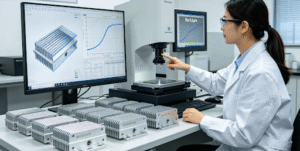
In-process measurement probes inspect critical dimensions immediately after each machining operation. When deviation is detected, the system automatically triggers tool compensation or halts production, maintaining process capability at CPK ≥ 1.67 — a benchmark for world-class manufacturing.
Multi-Dimensional Inspection Regime
- Dimensional and Surface Checks
Coordinate measuring machines perform 100% key-dimension checks on every critical feature. White-light interferometry statistically samples surface roughness, targeting Ra 0.2 μm or better.
- Material Verification and Data Integration
Optical emission spectroscopy confirms batch-to-batch material consistency. All data flows into a centralized database enabling real-time SPC dashboards. LS Manufacturing exemplifies this rigorous framework, holding ISO 14001 and IATF 16949 certifications.
Conclusion
In order to overcome the increasingly strict accuracy requirements of electronic devices, success can be achieved only through breaking away from the conventional approach of viewing the production process as “selling machine time.” A systematic approach involving state-of-the-art processes, intelligent control and thorough quality management is required.
Should you be looking for a partner capable of quickly turning your precise designs for electronic components into products, you should contact the aforementioned professionals who will offer you a free DFM report and an exact CNC machining quotation.
Author Bio
Jane Miller is a precision manufacturing industry analyst with over 15 years of experience, focusing on advanced CNC machining applications in consumer electronics, aerospace, and medical devices. She is dedicated to revealing efficient, reliable supply chain solutions for businesses.
FAQs
Q1: What is the minimum tolerance possible using CNC milling?
A: Advanced CNC milling techniques have the capability of achieving tolerances of ±0.005 mm with surface finish of Ra 0.2 μm for precision electronics and RF components..
Q2: What is the typical lead time for rapid prototyping?
A:Simple CNC milled parts can ship within 24 hours. Complex parts usually require 48–72 hours. Many professional service providers offer expedited channels for urgent projects.
Q3: How is part consistency ensured in high-volume production?
A:By implementing SPC and in-line measurement, process capability is maintained at CPK ≥ 1.67. First-article inspection and 100% key-dimension in-process checking are standard practices.
Q4: What is the smallest feature size that can be machined?
A:For demanding electronics, advanced micro-milling can produce features as small as 0.1 mm and holes with diameters of 0.3 mm, meeting extreme miniaturization requirements.
Q5: What else would you add to a quote?
A: Apart from material costs and machining time, there are other items that need to be added to an effective quote such as fixtures, surface treatment costs, expediting costs, and quality documentation. Selecting the right supplier would help.