
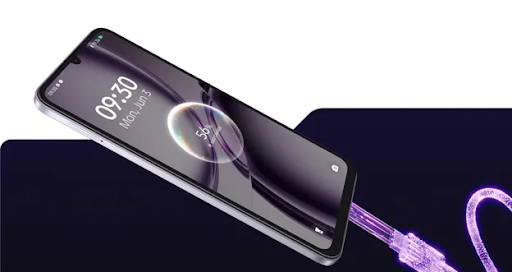
Your phone might survive the whole day with some battery percentage in the first month. But as time goes on, you need to charge your mobile phone twice a day so that it does not go down every so often, and after a year of use, you need a power bank to leave the house.
The phone and mAh number do not change, but the battery life starts to shrink. This blog will explain the real reasons why it shrinks over time, and what things make a mobile the best phone under 50000 in Pakistan, holding its battery life longer.
Why Smartphone Battery Life Shrinks Over Time
Most Android phones have a lithium-ion battery which starts to degrade with every charge cycle. A brand new battery starts to lose its health whenever you charge and discharge the phone. After 500 full charge cycles, 18-months of daily charging, most manufacturers expect the battery to retain 80% of its original capacity.
This means a phone that once gave you 12 hours is now giving you around 9 to 10 hours of usage, even if you charge it to 100%. The mAh number has not changed but the battery capacity has degraded.
A charge cycle is not the same as a single charge session. If your phone’s battery is at 50% and then you charge it to 100% twice counts as one charge cycle. This means that if you go from 100% to 40% in the morning, charge to 100% at lunch, and then drain to 70% by evening, that counts as roughly one charge cycle over the day.
At this rate, you will complete approximately 365 charge cycles in a year, putting the battery at around 80 to 85% health within 18 months of use. This is why a phone that starts with a larger, more efficient battery matters more than buyers realise. A 6,500mAh battery degraded to 80% capacity gives you 5,200mAh of effective performance.
The Biggest Reasons Smartphone Battery Health Declines
The way you charge your phone determines how long your smartphone battery is going to last. However, there are three other factors that degrade your battery health.
How Heat Damages Smartphone Battery Life in Pakistan
Heat is the number one enemy of battery health. Every 10°C above 25°C roughly doubles the rate of chemical degradation inside the battery. A phone left on the dashboard of a car parked in Lahore on a July afternoon is experiencing battery degradation at roughly eight times the rate of a phone kept in a cool room.
You do not have to leave it there for hours, even 20 minutes at that temperature causes measurable damage. Similarly, gaming or running heavy apps on a phone while it sits in direct sunlight compounds both internal heat from the processor and external heat from the environment at the same time.
The result is that battery health drops faster than the global average, which is why many Pakistani users find their phone’s battery weakening within 12 months rather than 18 to 24.
Why Charging Your Phone to 100% All the Time Can Reduce Battery Life
Leaving the phone plugged in all night keeps the battery at a high-stress 100% charge state for hours, which generates heat and accelerates degradation. A lithium-ion battery under moderate stress at 80% charge ages more slowly than one sitting at 100% for eight hours.
The practical fix most Pakistani users do not know is keeping charge between 20% and 80% is the single habit for battery longevity. This partial state of charge minimises both high-voltage stress at the top and deep-discharge stress at the bottom.
Instead of plugging in at midnight and waking up to a full charge at 6 am, plug in at 5 am and unplug when dressed. This alone can extend battery health across two to three years.
How Cheap Chargers and Load-Shedding Affect Battery Health
When your phone is charging and power is off, the transition to UPS involves a brief voltage spike or drop at the charger output. In a household experiencing 6 to 10 load-shedding events daily during summer, that is 180 to 300 transition events per month. Cheap chargers do not handle these changes, delivering inconsistent current to the battery with each UPS switchover.
Over a passage of time, this inconsistency compounds with the chemical degradation already happening. Using the original brand charger, or a certified high-quality alternative that handles voltage fluctuations cleanly, reduces this cumulative stress.
Always keep the phone plugged in through the UPS if load-shedding is expected, rather than unplugging and replugging repeatedly, as each reconnection initiates a new charging sequence that can spike current.
What Battery Features to Look for in the Best Phones Under 50000 in Pakistan
Look for phones with a starting battery of 5,000mAh or larger. The best phones under 35000 in Pakistan now offer 5,000mAh batteries, which are the new standard, and anything below that in 2026 will be a compromise that you will feel within a year.
At Rs. 50,000 and above, look for 5,500mAh or higher. The larger the starting point, the more capacity you have to lose before the phone feels worse.
Also check whether the phone has battery optimisation software or a charge-limiting feature. Modern phones from reputable brands include an optimised charging or adaptive charging mode that learns your routine and avoids keeping the battery at 100% for long durations.
If you charge overnight, the phone will charge to 80% quickly, hold there, and complete the final 20% just before your wake time, lowering the hours spent at high voltage. At the Rs. 30,000 to Rs. 50,000 price range in Pakistan, this feature separates well-engineered phones from spec-heavy but poorly optimised ones.
How to Choose a Smartphone With Better Long-Term Battery Life
A phone’s battery does not fail all at once, but it gradually loses capacity through daily charging, heat exposure, and the charging habits most people never think about. That is why two phones with the same battery size can feel completely different after a year of use.
When comparing the best phones under 50000 in Pakistan, do not focus only on the mAh figure. Look for a battery of at least 5,000mAh, hardware that creates less heat, and charging optimization features that help preserve battery health. These are the factors that determine whether your phone will still last comfortably through the day 18 months from now.