
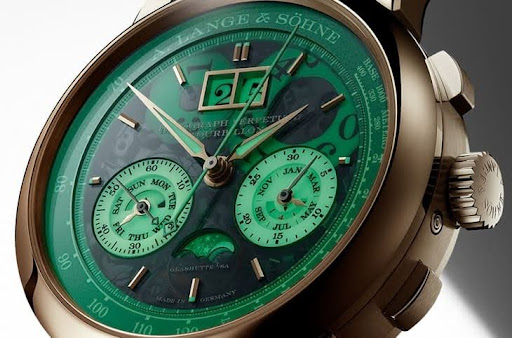
In the world of watches, lume is no longer just an extra feature you can ignore. For divers, it’s the only way to talk to time in the deep sea. For pilots, it’s a key reference to keep direction during night flights. For daily wearers, it’s how you check the time in a cinema, a parking garage, or when you wake up at night — without needing to light up your phone. What materials and techniques do replica watch factory typically use? Let’s talk about that today.
More and more watch lovers and collectors are looking for timepieces that “don’t compromise” on lume performance. watchfactory.io — as a platform that specializes in this area — has strict standards for judging the lume on every watch they feature.
How Lume Materials Have Evolved: From Radium to Super-LumiNova
Back in the 1920s and 30s, watchmakers first started using radium salt on military watches. This radioactive material was mixed with zinc sulfide to create a steady glow, and it quickly became standard on pilot and diver watches.
In the 60s, tritium tube tech came along. It was way less radioactive than radium and sealed inside glass tubes. The big plus of tritium is that it glows on its own — no need for an external light source, and it keeps glowing for over ten years. But downsides? Limited brightness and half-life decay.
The real game changer came in 1993, when Japan’s Nemoto & Co. came out with LumiNova. This strontium aluminate-based rare earth material had zero radioactivity and was way brighter than tritium. By 2000, the upgraded version — Super-LumiNova — made things even better.
Nowadays, Super-LumiNova is standard on high-end watches. Rolex’s Chromalight, Seiko’s Lumibrite — they’re all custom versions based on this same tech. Some top-tier replica watch factory now use Super-LumiNova Grade X1 as their default.
How to Scientifically Judge Lume Performance
Initial brightness is the first thing you notice when you go from a bright room into a dark one. High-quality Super-LumiNova, after being charged up, can give you a pretty stunning glow at first. But keep in mind: super bright at the start often means it fades faster.
Lume fade curve is how the brightness changes over time. In the industry, there are two common standards: “one-hour readability” and “all-night readability.” The first means that after 1 hour in the dark, you can still clearly see the dial and hands. The second means after 6 to 8 hours, you can still read the time.
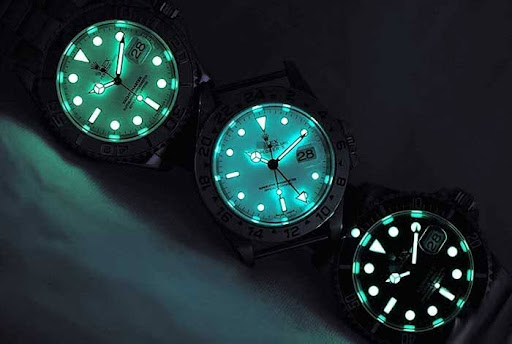
Color temperature and consistency shows how good the workmanship is. Super-LumiNova can be green, blue, ice blue, even purple. But what really shows top-level skill is whether all the lume parts on the same watch glow in exactly the same shade.
Coating evenness might be hard to see in daylight, but in the dark, any uneven thickness will stick out. Top-tier lume coating should be sharp-edged and even in thickness — like something printed — and that’s a real test of manual or machine coating precision.
Charge efficiency determines how it works in daily life. A good watch should have a high absorption rate for everyday light sources. You shouldn’t have to shine a flashlight on it on purpose to get decent lume.
Overview of Luminous Craftsmanship Among Major Replica Makers
In the high-end replica watches world, different factories care about lume quality to different levels — and their results vary.
Factory Lume Performance Comparison
| Factory Code | Representative Luminous Models | Luminous Grade | Decay Performance | Color Consistency | Craft Highlights |
| ZF Factory | Blancpain Fifty Fathoms, IWC Portuguese 7 | Grade X1 | 8-hour legibility | ★★★★★ | 27-step firing process, sapphire bezel lume |
| VS Factory | PAM 441, Omega Seamaster 300 | Grade A | 6-7 hour legibility | ★★★★☆ | Sandwich dial, matching integrated movement, free sprung |
| Clean Factory | Rolex Daytona, Submariner | Grade X1 | 6-hour legibility | ★★★★★ | Ceramic bezel lume pearl, precise hand centering |
| JF/AR Factory | AP 15703, Rolex Submariner | Grade A | 5-6 hour legibility | ★★★★☆ | Multiple version updates, 904L steel matching |
| GF Factory | Breitling Avenger Blackbird, Superocean | Grade A | 6-hour legibility | ★★★★☆ | In-house hand factory QC, large marker filling |
*Note: Luminous grade references Super-LumiNova classification, Grade X1 is enhanced type*
Testing Guide: How to Scientifically Test a Watch’s Luminous Performance
Before testing, make sure your watch is “zero-charge” — for example, leave it in total darkness for at least 4 hours. Use a daylight-simulating lamp or noon sunlight as your standard charge light source.
- Standardize the charge: put the watch 30cm from the light source for 3 minutes. This mimics a typical walk from indoors to outdoors, and is enough to get Super-LumiNova close to fully charged.
- Record at key times: check initial brightness right away (T=0), then at 5 min, 15 min, 30 min, 1 hr, 3 hrs, and 6 hrs. A good standard: after 1 hour you can still clearly see the dial, and after 3 hours you can still read the time in dark-adapted conditions.
- Check color consistency: in the dark, look at the hour hand, minute hand, second hand, markers, and bezel pip at the same time. See if there’s any color difference. High-quality lume should all glow in exactly the same shade — this is one of the core signs of a good replica watches.
Matching Luminous Performance with Watch Use Scenarios
Lume performance isn’t simply “the brighter the better.” It needs to match how the watches will actually be used. Different types of watches have very different lume needs.
Diver watches have the strictest lume requirements. The ISO 6425 standard says that in total darkness, you must be able to clearly read the time after just 5 minutes. That’s why diver watches usually have large coated areas, high-grade Super-LumiNova, and different designs for the minute hand vs the markers. ZF’s Blancpain Fifty Fathoms and C Factory’s Submariner are especially good here.
Pilot watches need to be readable at a glance. Models like IWC Big Pilot and Spitfire have oversized hour markers, full lume on Arabic numerals, and bold hands. ZF Factory has done great work on several models in this area.
Dress watches have lume that’s more “low-key.” Models like JLC Master and IWC Portugieser keep the dial elegant while adding just enough lume for basic nighttime readability.
Sports casual watches are somewhere in the middle. For most city wearers, the most useful lume moments aren’t deep sea or cockpits — it’s cinemas, parking garages, or checking the time in bed at night. This is also the most competitive segment among clone factories.
Care, Lifespan, and Usage Tips
Super-LumiNova is an inorganic phosphorescent material, very chemically stable. Under normal use, lume brightness barely fades in the first 10 years. The real factor affecting lifespan is physical damage, not chemical aging.
Cleaning note: dial and hand cleaning should be done by a pro. Using alcohol or solvents on the dial will likely dissolve the lume binder and cause permanent damage. Daily cleaning is only for the case and strap. If you see fog inside the crystal, send it for service right away.
How charging actually works: Super-LumiNova doesn’t need “maintenance charging.” It won’t lose its ability to glow if left in the dark for a long time, and it won’t get “tired” from frequent charging. Normal daily light exposure is enough to keep it working fine.
Conclusion
Lume might be the most “low-key” of all watch features. It doesn’t show off during the day. It only does its job in the dark. But that’s exactly what makes a watch a reliable tool — no matter when or where you need to know the time, it gives you the answer.
On platforms like watchfactory.io, lume performance is just as important as movement accuracy and material quality. Choosing a 1:1 Replica Watch with solid nighttime readability means having a dependable companion that doesn’t lose its shine just because the sun went down.