
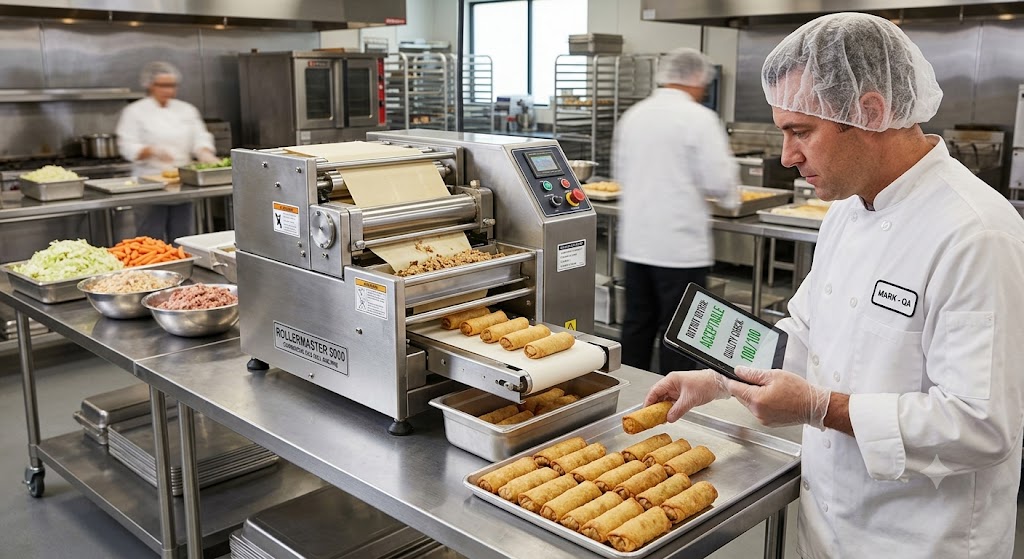
An output review for a commercial egg roll machine should do more than compare actual pieces with a rated number. Output is the result of temperature control, wrapper thickness, filling behavior, staffing, packing response, and maintenance condition. Once the review only reports that production was below target, managers learn very little. For the plant, a better review explains why the line produced the number it produced.
UDTECH lists the UD05-2 at 220 pieces per minute and about 600 kg per 8-hour shift. During this review, the uD05-3 is listed at 330 pieces per minute and about 900 kg per shift. Published features include temperature control, variable wrapper thickness, automatic core injection, and forming. These facts give managers a useful baseline, but the review must connect the baseline to real shift evidence.
Separate designed output from usable output
Designed output is the capacity the machine can support under the right conditions. Usable output is what the plant can sell with acceptable quality during a real shift. For the shift leader, the gap between the two can come from packing delay, material preparation, changeover time, operator learning, or repeated minor defects. In practice, the output review should identify the gap before managers blame the wrong cause.
This distinction protects ramp-up decisions. During review, a plant may not need a machine change if usable output is limited by downstream cooling or labor. For the team, it may need better training if repeated pauses happen after setting changes. At release time, the review should make these differences visible.
Build the output review
Output review fields for commercial egg roll production
| Review field | Evidence to record | Management question |
| Production window | Start time, stop time, planned speed, and actual output | Was the line given a fair run window? |
| Quality result | Reject count, accepted sample, color note, and roll tightness | Was output usable or only fast? |
| Process constraint | Packing delay, cooling space, material wait, or staffing gap | Did the machine or the process limit output? |
| Technical note | Temperature behavior, wrapper setting, filling position, and maintenance issue | Which control point needs action? |
Use reject count beside speed
Speed without reject context can be misleading. Each shift may hit a high piece count while creating too many rejects, or it may run slower with strong product quality during training. On the floor, the output review should show reject count beside speed and should note when rejects began. If defects rise after restarts or speed increases, the next action is different from a defect that appears during warm-up.
Managers reviewing a commercial egg roll machine output review should look for timing. Did color drift after a pause? Did wrapper cracks appear only after an output increase? Did filling position change after a flavor switch? These questions connect output numbers to the control points that operators can actually manage.
Compare model targets with surrounding flow
The UD05-2 and UD05-3 output references are useful when the review includes surrounding flow. One 600 kg or 900 kg shift target requires enough feeding, cooling, inspection, and packing response. If those supports are weak, the machine may wait even though its own forming and injection functions are ready. From a manager’s view, the review should name the constraint rather than reducing the issue to a single output percentage.
Surrounding flow can change by shift. One team may have stronger packing coverage, while another may have stronger maintenance support. During this review, the review should include shift context so managers do not treat all output differences as machine variation.
Name limits before increasing speed
An output review should include limits that must be solved before speed increases. These may include unstable batter, repeated restart defects, no spare-part response, weak handoff notes, or packing congestion. Naming limits protects the plant from chasing rated output before the process is ready.
Some limits are temporary. Training may improve after a week, and packing flow may improve after layout changes. Other limits need a supplier or maintenance response. For the shift leader, the review should distinguish between them so management can assign the right owner.
Turn the review into a next-run decision
The output review should end with a next-run decision. In practice, the line may hold the same speed, increase after one proof point, reduce speed for a controlled run, or stop for technical action. At release time, the decision should reference evidence from the review. This keeps production meetings focused on action instead of general disappointment or confidence.
UDTECH support can use the same review when a buyer needs help during ramp-up. A clear record of model, speed window, reject pattern, temperature note, wrapper setting, and filling evidence gives support a practical starting point. Output then becomes a managed signal, not a vague complaint.
Add short notes beside long numbers
Numbers need notes. A shift total can look precise while hiding the reason behind it. One short sentence can explain whether output was limited by warm-up, wrapper adjustment, filling checks, packing response, or maintenance access. On the floor, the note does not need to be polished. It needs to be true. Short notes keep the review readable and raise sentence variation in the record itself.
UDTECH’s rated model output should sit beside these notes. From a manager’s view, the review can show that the plant is moving toward the UD05-2 or UD05-3 target, but it should also show what condition must improve next. A number without that next condition is not a management decision. It is only a score.
Compare three windows, not one shift
A single shift can be misleading. Compare warm-up, stable production, and restart recovery as three separate windows. The line may perform well after warm-up but lose time at each restart. It may hold speed while packing falls behind. It may show wrapper defects only after a setting change. Three windows give managers a clearer picture than one total.
This review style also helps separate temporary ramp-up from repeated process limits. One weak warm-up may be training. Three weak warm-ups with the same symptom deserve a corrective action. The output review should make that pattern visible before frustration replaces analysis.
Keep quality in the same report
Output and quality should not live in separate reports during ramp-up. If production counts are reviewed without reject data, managers may push speed too early. If reject data is reviewed without output context, managers may hold the line too conservatively. The same report should include accepted samples, reject count, temperature notes, wrapper condition, and filling observations.
UDTECH support may need that combined view. A support question about output can turn into a question about temperature recovery or wrapper thickness once the evidence is visible. Keeping the data together shortens that path.
State limits before the next target
The review should state limits before it recommends the next output target. A limit might be packing congestion, unclear restart rules, or repeated filling drift. It might be a maintenance follow-up that needs one more run. The next target should respect those limits. Pushing past them can create a higher number for one day and a larger problem the next day.
Some limits are simple. Add a packer. Move a tray. Rewrite a restart rule. Others need more evidence. The output review should say which type of limit is present so the next action is realistic.
End with one practical change
The best output review ends with one practical change for the next run. That change might be a different warm-up record, a clearer wrapper setting note, a staged speed boundary, or a packing response test. One change is easier to execute than a list of general improvements.
After the next run, the team can ask whether the change worked. If it did, the review becomes part of standard work. If it did not, the plant has better evidence for the next decision or for a focused conversation with UDTECH.
Use one long observation when the pattern is complex
Most review notes should be short. Sometimes one longer observation is useful because the pattern crosses several control points: the line warmed up correctly, the first accepted sample passed, output increased, packing slowed, workers held finished rolls near the line, wrapper cracking appeared after the wait, and the next restart took longer than the first. That sentence is long, but it preserves the chain of events. It tells a better story than five isolated fragments.
Then write a short action. Reduce the next speed step. Add packing support. Recheck wrapper thickness after any wait longer than the agreed pause. Short and long notes together make the output review easier to read and easier to act on.
Do not hide the awkward note. Write it. The review may say that output looked low because the team stopped three times to protect quality while wrapper thickness was being corrected after a packaging delay, and that single sentence gives management a more accurate picture than a clean number with no context. Then make the next run smaller, cleaner, and easier to judge.
One number is not enough. A longer note can show that the line ran well until the cooling table filled, the operator paused to avoid crowding finished rolls, the restart created a short color drift, and the team correctly held speed until the accepted sample returned. Good. That is a usable review.