
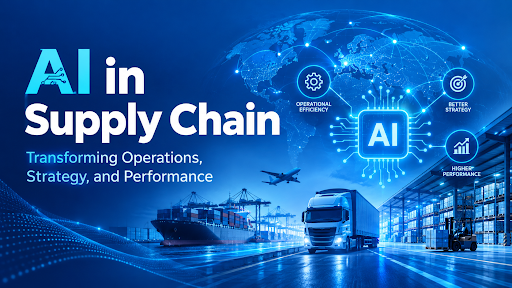
Artificial intelligence is changing how organizations plan, source, manufacture, distribute, and manage supply networks. AI in supply chain helps businesses analyze large volumes of data, anticipate disruptions, automate decisions, and improve operational efficiency. As supply networks become more complex, organizations need intelligent capabilities that connect planning, execution, and decision-making across the enterprise.
How AI Is Transforming Supply Chain Operations
AI enables organizations to move from reactive processes toward predictive and proactive decision-making. By analyzing historical and real-time information, intelligent technologies can identify patterns, anticipate demand changes, detect risks, and recommend actions that improve agility across supply chain operations.
Improving Demand Forecasting
AI can analyze sales history, market signals, customer behavior, seasonality, and external factors to improve demand forecasts. More accurate predictions help organizations align inventory, production, procurement, and distribution with expected demand while reducing stockouts, excess inventory, and unnecessary operating costs.
Optimizing Inventory Management
Intelligent analytics can continuously evaluate inventory levels, lead times, demand patterns, and supplier conditions. Organizations can use these insights to determine appropriate stock levels, identify potential shortages, and improve replenishment decisions, supporting stronger supply chain performance while reducing working capital requirements.
AI Across Supply Chain Functions
AI can support multiple supply chain functions, from procurement and planning to logistics and warehouse management. Integrating intelligence across these areas creates greater visibility and enables organizations to coordinate decisions instead of optimizing individual activities in isolation.
Procurement and Supplier Management
AI can evaluate supplier performance, spending patterns, contracts, market information, and risk indicators to support procurement decisions. Organizations can identify opportunities for savings, anticipate supplier disruptions, and prioritize strategic actions while strengthening supplier relationships and improving resilience across the supply network.
Logistics and Transportation
AI-powered solutions can optimize routes, delivery schedules, transportation capacity, and distribution decisions. By analyzing traffic, demand, shipment information, and operational constraints, organizations can identify more efficient transportation options, improve delivery reliability, reduce costs, and respond faster when logistics conditions change.
Warehouse Operations
AI can improve warehouse productivity by supporting demand-based inventory placement, picking optimization, labor planning, and operational monitoring. Intelligent systems can identify bottlenecks and recommend adjustments, helping organizations improve throughput, reduce manual effort, and create more responsive distribution operations.
Building an AI-Enabled Supply Chain Strategy
A successful supply chain strategy should connect AI opportunities with measurable business priorities. Rather than introducing technology without a clear objective, organizations should identify high-value processes, evaluate data readiness, define appropriate use cases, and establish a roadmap for scaling intelligent capabilities.
Strengthening Supply Chain Management
AI can enhance supply chain management by connecting planning, sourcing, manufacturing, logistics, and inventory decisions through shared intelligence. This integrated approach provides leaders with greater visibility into operational conditions and helps teams respond to changing demand, risks, and business priorities more effectively.
Measuring Supply Chain Performance
Organizations need measurable indicators to evaluate whether AI investments are delivering value. Supply chain benchmarks can provide useful comparisons for cost, productivity, service levels, cycle times, and other operational metrics, helping leaders identify performance gaps and prioritize improvement opportunities.
Choosing the Right Supply Chain Solutions
Modern supply chain solutions can combine predictive analytics, machine learning, automation, optimization, and generative AI capabilities. Selecting the right technology requires organizations to consider existing systems, data quality, integration requirements, scalability, security, and the specific operational challenges they need to address.
Connecting the Supply Chain System
An effective supply chain system should provide connected information across planning and execution processes. AI can enhance these environments by identifying relationships between datasets, generating actionable insights, and supporting faster decisions without requiring teams to manually consolidate information from disconnected sources.
Scaling Supply Chain Services
AI can strengthen supply chain services by enabling more responsive planning, analytics, exception management, and operational support. Organizations can use intelligent capabilities to automate repetitive activities while allowing specialists to focus on complex decisions, strategic initiatives, supplier relationships, and continuous improvement.
Overcoming Challenges in AI Adoption
Successful AI adoption requires more than selecting a technology platform. Organizations must address data quality, integration, governance, cybersecurity, workforce readiness, and change management. A structured approach helps businesses establish responsible AI capabilities while creating the foundation required for long-term transformation.
From AI Adoption to AI Transformation
AI transformation involves redesigning processes around intelligent capabilities rather than simply adding AI to existing workflows. Organizations can identify opportunities where AI changes how decisions are made, work is performed, and resources are allocated, creating more scalable and responsive supply chain operating models.
Improving AI Performance
Measuring AI performance requires more than evaluating model accuracy. Organizations should track business outcomes such as cost reduction, forecast improvements, productivity, service levels, cycle times, and risk reduction. These measures demonstrate whether AI initiatives are producing tangible operational and financial benefits.
Accelerate Supply Chain Transformation With AI
Implementing AI across supply networks requires a combination of business strategy, technology expertise, process knowledge, and change management. Organizations need a clear roadmap that moves from opportunity identification and prioritization to implementation, measurement, and continuous improvement.
Partner With AI Experts
Experienced AI consultants can help organizations identify practical opportunities, assess technology and data readiness, prioritize investments, and establish governance. Working with specialists can reduce implementation complexity and help supply chain leaders move from isolated experiments toward scalable AI capabilities aligned with business objectives.
AI Consulting for Supply Chain Leaders
AI consulting services can support organizations throughout the transformation journey, from developing an AI strategy to designing use cases and implementation roadmaps. With the right AI consulting approach, businesses can connect AI investments to supply chain priorities and create measurable value across critical operations.
Accelerate AI Development
Effective AI development should focus on business outcomes, scalability, integration, and user adoption. Organizations can develop intelligent applications that work with existing enterprise systems while incorporating relevant data and workflows, enabling supply chain teams to access insights and automate decisions within their daily operations.
Build a Smarter Supply Chain With The Hackett Group®
Building an AI-enabled supply chain requires more than adopting new technology. It requires a clear strategy, the right use cases, connected data, and an operating model designed to turn AI-driven insights into measurable business outcomes. The Hackett Group® helps organizations identify high-value opportunities, assess AI readiness, benchmark supply chain performance, and develop practical transformation roadmaps aligned with their business priorities.
From demand forecasting and inventory optimization to procurement, logistics, and supplier risk management, AI can help organizations improve visibility, accelerate decision-making, reduce costs, and strengthen resilience. With the right approach, businesses can move beyond isolated AI initiatives and build scalable capabilities that continuously improve supply chain performance.
Partner with experienced AI and supply chain specialists to identify where AI can deliver the greatest value, prioritize investments, and accelerate the transition toward a more intelligent, agile, and high-performing supply chain.